

How to Improve Profitability in the RMC Business with the Right ERP Software
How to Improve Profitability in the RMC Business with the Right ERP Software
 Kumar Rajesh
Profitability in the RMC Business is not determined by order volume alone. Strong sales can still yield limited margins when materials are wasted, vehicles make unnecessary trips, mixers sit idle, production is poorly planned, deliveries are delayed, invoices are raised late, or management lacks timely visibility into actual operating costs.
Every stage, from stock and production to delivery, billing, and payment, affects what remains after a sale. Protecting margins therefore requires control across the entire operational cycle. RMC ERP Software for concrete batching business helps teams manage materials, production, fleet, dispatch, and finance together, so decisions are based on current operational data rather than disconnected records.
What Affects Profitability in Ready-Mix Concrete?
RMC profitability depends on how effectively a plant manages materials, production capacity, transportation, deliveries, and cash flow. When these areas are not properly controlled, costs can increase even when order volumes remain strong.
Key factors that directly influence profitability include:
Raw Material Costs: Cement, aggregates, and admixtures represent a major part of production costs. Excess consumption, wastage, and stock discrepancies can increase the actual cost of each load.
Production Efficiency: Poor production planning, overproduction, underproduction, plant downtime, and batching errors can result in material losses and underutilized plant capacity.
Transportation Costs: Fuel consumption, empty trips, vehicle idle time, poor utilization, and delayed maintenance can increase concrete transportation costs.
Order and Dispatch Management: Inefficient scheduling, delayed deliveries, incorrect vehicle allocation, and poor site coordination can affect daily delivery capacity and customer satisfaction.
Billing and Collections: Delayed invoicing, outstanding payments, and limited visibility into receivables can slow cash flow and affect the funds available for ongoing operations.
Why Profitability Requires End-to-End Visibility in RMC Operations
An RMC business operates as one connected chain: order, production, inventory, dispatch, fleet, delivery, billing, and payment. An issue at one stage can affect the next and eventually appear as additional fuel costs, idle mixers, delayed deliveries, material losses, or late payments.
For this reason, profitability cannot be improved by looking at individual departments in isolation. Management needs visibility across the complete operational cycle.
Shadow infosystem’s ready mix concrete plant ERP solutions bring production, dispatch, inventory, fleet, sales, finance, and quality into one platform, helping teams maintain connected operational records and make informed decisions.
Common Mistakes That Reduce RMC Profitability
Operational practices can also reduce profitability by making it difficult to identify problems early. Common examples include:
Spreadsheet Reliance: Managing changing orders, trips, inventory, and invoices through disconnected spreadsheets can make it difficult to maintain consistent, up-to-date records.
Weak Material Tracking: If consumption is not regularly monitored against production requirements and available stock, material losses may go unnoticed.
Poor Production Planning: Unplanned batching can result in overproduction, waiting, or last-minute production changes.
Ignored Fuel Trends: Reviewing fuel expenses only at the end of the month makes it harder to identify unusual consumption or the operational reasons behind it.
Underused Vehicles: Mixers that spend excessive time waiting or running empty continue to generate operating costs without contributing efficiently to deliveries.
Delayed Billing: Raising invoices several days after delivery can slow collections and affect working capital.
Isolated Departments: When production, transport, dispatch, and accounts teams maintain separate records, management may not have a complete view of operational and financial performance.
Decisions Without Current Data: Outdated reports can prevent teams from responding quickly to vehicle delays, inventory requirements, production issues, or pending payments.
No Plant Comparison: Businesses with multiple plants may struggle to identify performance gaps when each location follows different processes or reporting methods.
As an RMC business grows, these challenges become harder to manage manually. A centralized ERP software for RMC industry can provide a common operational framework across departments and locations.
8 Ways to Improve Profitability in Ready-Mix Concrete
Improving margins requires better control over the activities that directly influence operating costs. An integrated Ready Mix Concrete ERP Software can connect inventory, production, fleet, dispatch, fuel, billing, and reporting so teams can manage these activities through a common system.
The following eight ways explain how RMC software in India can help RMC businesses improve operational control, reduce avoidable costs, boost efficiency, and strengthen profitability.
1. Control Raw Material Consumption
Inventory and procurement records can help teams monitor cement, aggregates, and admixtures from receipt to consumption. Tracking actual usage against requirements can help identify excessive consumption, reduce wastage, prevent stock mismatches, and support better purchase planning.
2. Improve Production Planning
Production planning and batching controls help align production with confirmed orders, material availability, and plant capacity. This can reduce unnecessary production, improve batch utilization, limit material losses, and reduce idle plant capacity.
3. Optimize Fleet Utilization
Vehicle scheduling, trip planning, availability records, maintenance history, and vehicle-wise performance data help teams understand how effectively mixers are being utilized. This can help identify idle or underused vehicles and reduce avoidable empty trips.
4. Control Fuel Costs
Fuel tracking provides visibility into vehicle-wise consumption, mileage, fuel issues, and related costs. Monitoring these records can help identify unusual consumption patterns and areas where fuel expenses may be increasing.
5. Improve Dispatch Efficiency
Connecting orders, vehicle allocation, and dispatch schedules helps teams coordinate deliveries more effectively. Better scheduling can reduce avoidable waiting, improve vehicle turnaround, and support greater daily delivery capacity.
6. Strengthen Billing and Cash Flow
Faster invoice generation, accurate GST invoicing, receivables tracking, payment follow-ups, and expense monitoring can help businesses shorten billing cycles and maintain better visibility into incoming and outgoing cash.
7. Use Real-Time Data to Identify Cost Leaks
Real-time dashboards and MIS reports can bring together information from inventory, production, dispatch, fleet, fuel, sales, expenses, and receivables. This allows managers to identify operational issues as they happen, instead of relying only on end-of-month reports.
8. Manage Multiple Plants Centrally
For businesses operating across several locations, centralized plant-wise information and consolidated reporting can make it easier to compare performance, standardize processes, and identify locations that require corrective action.
How Shadow infosystem’s RMC ERP Supports These Profitability Goals
The above practices become easier to manage when operational information is connected through a single system. Shadow infosystem provides Ready Mix Concrete ERP Software in India that brings inventory, procurement, production, dispatch, fleet, fuel, billing, finance, and reporting together on a centralized platform.
Inventory Management: Tracks cement, aggregates, admixtures, receipts, issues, and stock levels to support better material control.
Procurement Management: Helps align purchasing with actual consumption and operational requirements, supporting better purchase planning.
Production and Batching: Connects production planning with confirmed orders, material availability, and plant capacity to reduce unnecessary production and resource losses.
Order and Dispatch Management: Coordinates orders, vehicle allocation through third-party API integration, and delivery schedules to improve dispatch efficiency and reduce avoidable delays.
Fleet Management: Maintains vehicle, trip, maintenance, insurance, and driver records while supporting GPS API integration for real-time vehicle tracking software for RMC plants.
Fuel Management: Records fuel issues, vehicle-wise consumption, mileage, and fuel costs to help identify excessive consumption and control transportation expenses.
Finance and Accounts: Supports GST invoicing, receivables, payables, expenses, and financial reporting to improve financial control and cash-flow visibility.
Quality Management: Keeps mix and test records connected with production processes for consistent quality monitoring.
Multi-Plant Management: Provides centralized control and standardized processes across multiple RMC plants, with consolidated information for management review.
Get Real-Time Operational Control with RMC ERP Software
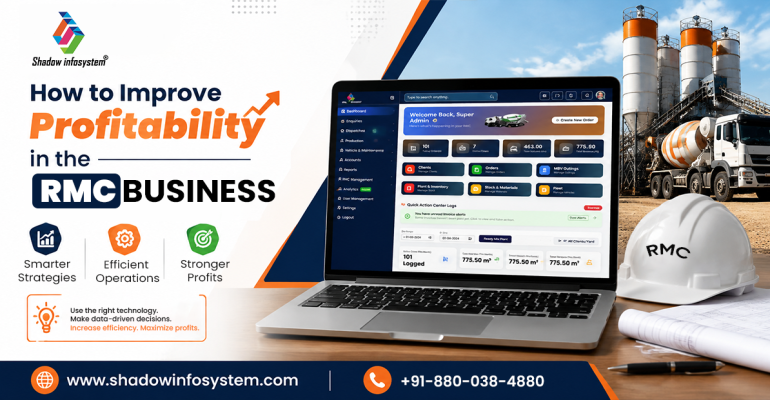
Shadow infosystem’s Ready Mix Concrete Software provides a centralized view of key RMC operations, helping teams monitor activities across inventory, production, dispatch, fleet, fuel, sales, and finance. Real-time visibility provides live data across all operations, allowing management to track ongoing activities and respond promptly to operational issues.
The Fleet Management module supports secure third-party GPS API integration for real-time vehicle tracking. This enables relevant location and tracking data from compatible third-party GPS tracking systems to flow into the software, giving teams better visibility into vehicle movement and delivery status.
The platform also maintains vehicle information, trip planning, dispatch schedules, maintenance history, fuel consumption, vehicle insurance, driver records, and driving license (DL) expiry tracking in one place.
Management, dispatch, plant, fleet, and finance dashboards present operational information through interactive charts, alerts, and drill-down reports, helping teams monitor current performance without relying on disconnected records.
RMC ERP Capabilities and Their Profitability Impact
Improving profitability in an RMC business requires better control over materials, production, fleet, dispatch, billing, and overall operations. Shadow infosystem’s Ready Mix Concrete ERP Software brings these functions together on a single platform, helping businesses manage day-to-day operations more efficiently and reduce avoidable costs.
The table below shows how different ERP capabilities can help address common RMC challenges and support better profitability:
| RMC Challenge | Shadow infosystem RMC ERP Capability | Profitability Impact |
| Material wastage and inaccurate stock records | Raw Material & Inventory Management | Better control over material consumption, stock levels, and wastage |
| Inefficient production planning | Production Planning & Control | Better resource utilization and improved production efficiency |
| High fuel consumption and fleet-related costs | Fleet & Fuel Management | Better monitoring of fuel consumption and vehicle-related expenses |
| Dispatch delays and poor vehicle coordination | Dispatch & Delivery Management | Better trip planning, vehicle utilization, and delivery coordination |
| Limited visibility into vehicle movement | Third-Party GPS API Integration | Real-time vehicle visibility for better delivery coordination and fleet monitoring |
| Delayed billing and payment follow-up | Sales, Billing & Finance Management | Timely invoicing, better receivables tracking, and improved cash-flow visibility |
| Limited visibility across daily operations | MIS & Dashboards | Real-time operational visibility for faster monitoring and informed decisions |
| Managing multiple plants and locations | Multi-Plant Management | Centralized monitoring and more consistent operational control |
Shadow infosystem’s cloud-based RMC ERP connects major RMC operations in one place. This helps teams track daily activities, identify problems quickly, control costs, and make better decisions to improve overall profitability.
Build a More Profitable RMC Business with Better Operational Control
Profitability in ready-mix concrete depends on controlling materials, production, fleet, deliveries, fuel, billing, and cash flow throughout the operational cycle. When these activities are managed through disconnected systems, cost leaks and inefficiencies can be difficult to identify.
Shadow infosystem’s RMC ERP brings these functions together on a centralized platform, helping businesses improve operational control, maintain better visibility, and make informed decisions based on current data.
Ready to Improve Profitability Across Your RMC Operations?
Connect with Shadow infosystem to discuss your RMC ERP requirements and see how our centralized solution can help improve control across inventory, production, dispatch, fleet, fuel, finance, quality, and multi-plant operations.
FAQs
1. How can I choose the best batching plant software company in Delhi, Mumbai, Bangalore, or Chennai?
Choose a batching plant software company that offers RMC-focused features such as production planning, inventory, dispatch, fleet, fuel, billing, GPS integration, and real-time reporting.
2. Can batching plant software help RMC businesses manage multiple plants across different cities?
Yes. A centralized batching plant software can help manage multiple RMC plants across Delhi, Mumbai, Bangalore, Chennai, and other locations with plant-wise monitoring, consolidated reports, and centralized operational control.
3. What is a Cloud RMC ERP for multiple plants?
A Cloud RMC ERP for multiple plants is a centralized software solution that helps RMC businesses manage inventory, production, dispatch, fleet, billing, finance, and other operations across different plants from a single platform.
4. What is batching plant management software?
Batching plant management software helps RMC businesses manage plant operations such as raw material inventory, concrete production, batching, order management, dispatch, vehicle tracking, fuel, billing, and reporting from a centralized platform.
5. What does a batching plant software company in India provide?
A batching plant software company in India provides software solutions to manage RMC plant operations, including raw material inventory, production and batching, order management, dispatch, fleet, fuel, billing, finance, quality, and MIS reporting.